

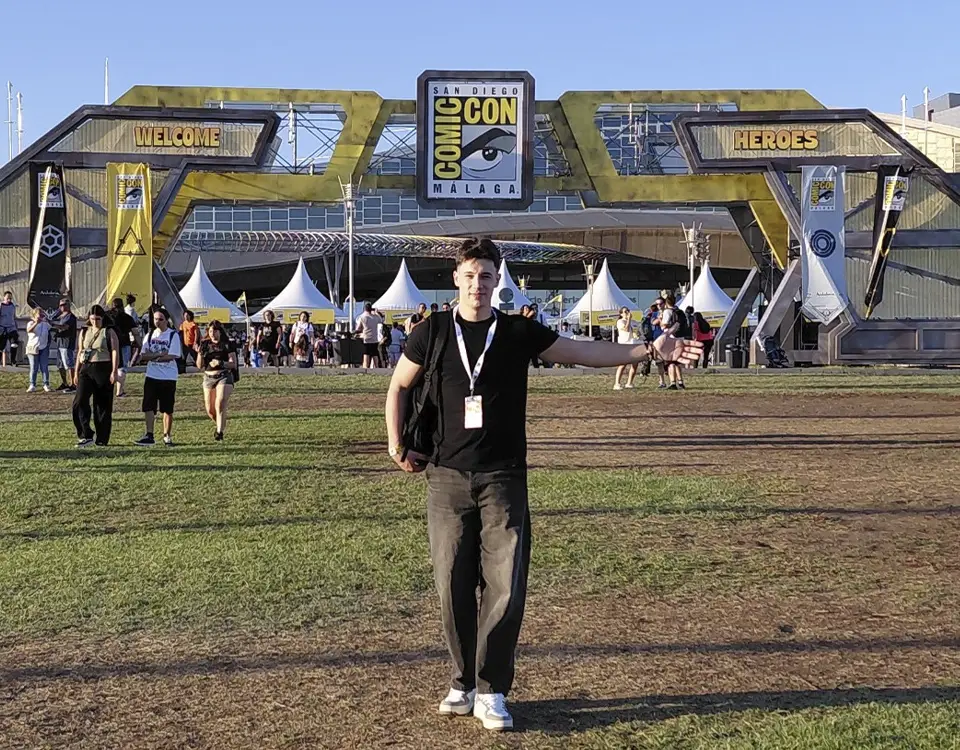
Rafael Pérez Granados (Iznájar, Córdoba, 1999) is an artist who participated in the first edition of Portfolio Review at San Diego Comic-Con Málaga in 2025. After taking part in this initiative, which connects creative talent with publishing houses, Rafa landed his first job at Marvel. His story is pure inspiration.
1. Rafa, how did you get started as an illustrator?
I’ve always loved drawing, although I also played sports and video games. In middle school, I wasn’t sure what I wanted to study. I chose the Art track in high school to give myself time to decide, and after that, I was going to do a vocational program in photography. But when I went to the website of the Mateo Inurria School of Art in Córdoba to sign up for the photography program, I discovered the illustration program. And I thought, “This is what I want to do.”
There, I had teachers like Marta Morón, who really opened my eyes to artists I hadn’t known about before. I discovered Sergio Toppi, Bernie Wrightson, and, above all, I was deeply inspired by the story of Jorge Jiménez, the artist from Granada who works for DC. That’s when I decided I wanted to try my hand at the American comic book market.
2. How did you find out about the San Diego Comic-Con Málaga Portfolio Review?
I found out through an Instagram Story. I was already putting together my portfolio when I saw that San Diego Comic-Con Málaga was hosting Portfolio Reviews.
I told myself, “Since I already have my portfolio ready and I live relatively close by, I’m going to give it a try.” I applied without even knowing who would be reviewing the portfolios, and a few days later, I received word that I would be interviewed by C.B. Cebulski, Marvel’s editor-in-chief.
3. How was the event organized?
The truth is, it was really convenient. Compared to other events, it was one of the ones that provided the most instructions: how to bring your portfolio, how to get to the event, credentials, schedules… That helps a lot because you arrive with less uncertainty and can focus on showcasing your work.
4. What exactly did you bring to the interview?
I always carry a binder clip with me—my printed portfolio looks just like a little comic book, with a front and back cover.
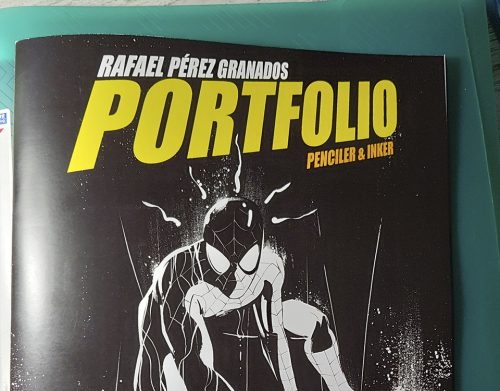
In this case, it included about twelve pages of sequential storytelling, several scenes of four, five, or six pages each, a few covers, and some pin-ups. What they want to see is whether you can tell stories: characters, backgrounds, action, cities, animals, cars… The more you can show them, the better.
Every so often, Marvel publishes a script so that any artist in the world can draw their own version. I submitted my version, and when C.B. Cebulski saw it, he told me he really liked how I’d drawn the characters and the changes I’d made. There are things that appear a certain way in the script , and you can reinterpret them to bring something different to the table—and they appreciate that, too.
He asked me to mail him my portfolio so he could have my contact information, and since we also knew we’d be seeing each other shortly afterward in New York, he told me we’d continue our conversation there at a more leisurely pace.
5. What was it like to sit across from Marvel’s editor-in-chief?
Look, here’s a little story: just a few months earlier, I’d been in touch about twice with the recruiter—let’s say his name is Ricky Purdy. Back in 2025, a few months earlier, I’d gone to an event in Utrecht, in the Netherlands, and Ricky Purdy was actually there reviewing portfolios. So, when I got to the interview with Cebulski at San Diego Comic-Con, I told him, “Look, I met Ricky a few months ago, or something like that. We’re kind of like friends now.” And he said, “Well, I’m going to take a picture of you and send it to them to see if they actually know who you are.” It was fun.
Plus, they’re always super friendly and try to speak clearly in English because they know it’s not your first language.
6. Many people don’t apply because they’re afraid of English. What would you say to them?
Don’t let that hold you back. English helps, of course, but the most important thing is that your work speaks for itself.
If your portfolio is good, that’s what they’re interested in. Plus, most of the communication afterward is via email, so you can rely on translators. And seriously: they’re not going to eat you—they’re just normal, super friendly people.
It’s true that it’s important to know English and be able to communicate with them, but I think the most important thing is for your work to speak for itself. If your English is very basic but you show them work that’s worth seeing, that won’t be a problem. Besides, communication is usually done by email, and you can use a translator.
Don’t let that put you off. They’re not going to eat you; they’re normal, super-friendly people. If you don’t understand something, just ask them to repeat it, and it’s no big deal at all.
7. How did you prepare for the interview?
I, for example, brought a notebook with questions jotted down. It was a tip we’d been given by the organizers of San Diego Comic-Con Málaga, and it really came in handy because, when you’re there and nervous, you tend to forget a lot of things. I think it also shows that you’re taking it seriously and that you’ve prepared for it.
8. What happened after the Portfolio Review?
Shortly after that, Ricky Purdy wrote to me to say that he had spoken with C.B. Cebulski, that he had shown him more samples of my work, and that they were trying to find a project for me at Marvel.

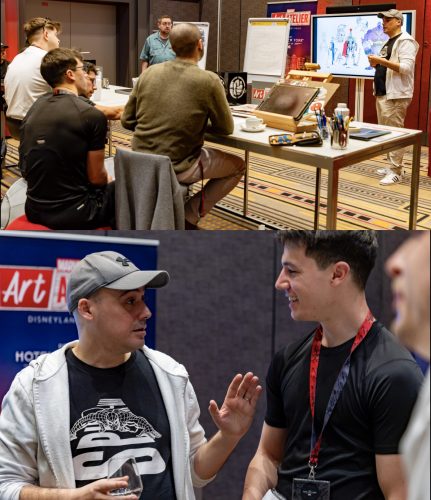
And before I knew it, I received another very important piece of news: I was selected to participate in Marvel Atelier, a program they organize every year at Disneyland Paris. Each year, they choose five artists whom they believe are very close to landing a job with Marvel. Spanish artists such as Danny Parker, Adrián Bonilla, and Rose Villalobos had previously participated in the program.
9. What was your experience at Marvel Atelier like?
It was a turning point. For a week, we spent time with editors and artists such as Elena Casagrande, Humberto Ramos, Iván Coello, and Adi Granov. They had all gone through the same process years earlier and gave us a lot of advice.
The best part was strengthening my relationship with the editors. It was no longer just a professional relationship; you end up spending several days with them, talking a lot, and gaining a better understanding of how everything works.
10. When did you feel like you were getting close to your dream of working for Marvel?
When Marvel Atelier wrapped up, I had a conversation with Ricky Purdy. He asked me what I planned to do next, and I told him I would keep promoting my work, just as I always had. Then he replied, “I want you to rest assured that we really like your work. We want you to be part of Marvel for years to come.”
That really put my mind at ease. When you’ve been trying for so many years and you see that you’re so close, hearing something like that gives you a lot of confidence.
11. How did you land your first job at Marvel?
At a publishing house, everything works like a cog in a wheel: your work may be ready, but the right project has to come along at just the right time. In my case, the opportunity arose with *Spider-Versity*. It was a Spider-Man comic, and they needed a filling artist—a backup artist. The lead artist was Pere Pérez, from Barcelona, and, due to various circumstances, they needed help to meet the deadline.
It just so happened that I was available; the editors looked at my portfolio, and I also had several pages of Spider-Man with me. Everything fell into place. I drew four pages of Issue #2 and the entire Issue #3. That was the moment when all those years of work and that bit of luck—which is also necessary—came together.
12. What advice would you give to someone who dreams of participating in a Portfolio Review?
Don’t hesitate to join in. You’ve got nothing to lose! This is a process that takes time, and you have to think of it as a marathon. I always say that it’s not the fastest runner who wins, but the one who never stops moving forward. Sometimes you’ll be running, other times walking, and other times just crawling, but the important thing is to keep moving forward.
They should listen, surround themselves with people who can help them grow, and put their egos aside, because that won’t allow them to move forward. There are countless examples in Spain of people who have succeeded. Everyone has their own story and their own pace, but it can be done.
And, above all, enjoy the process. In this line of work, there are some really good days and some really tough ones, but for me, the key right now is to enjoy every page and every project. Every project that comes my way is a gift.